- Coral
- Fish
- Plants
- Turtles
- Invertebrates
- Birds
While the archipelago has not fully escaped the ravages of climate change, it remains home to at least 300 types of coral and is critically important to global coral conservation efforts.
The reefs in the Indian Ocean have been hit hard by human activities, but almost half of those that remain in good condition are located in the Chagos Archipelago.
Reefs are exceptionally diverse ocean habitats. They offer vital protection of coastlines, and provide nutrients that nourish the marine food chain. But 19% of the world’s reefs have already been lost, and a further 35% could be gone by 2050. Rising sea temperatures, over-fishing and acidification are very real threats to those that remain.
One of the biggest threats to coral reefs is coral bleaching, which is caused by factors such as rising seawater temperatures. A single event in 1997/98 devastated as much as 16% of the world’s reefs. While some reefs recovered following this event, bleaching is now happening so frequently that few reefs have time to recover between incidents.
“It’s not just that the reefs are beginning to die” said Dr Mark Spalding, Senior Marine Scientist at The Nature Conservancy, “It’s what they take with them. These are the rainforests of the sea, but they are also critical to people. They may be the first and most sensitive ecosystems to succumb to climate change, but they will not be alone.”
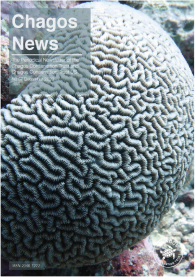
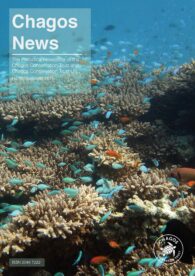
The archipelago is home to the endemic brain coral (Ctenella chagius) and thick strands of branching staghorn coral (Acropora sp). It is a vital natural laboratory for scientists to learn how a healthy reef lives, and key to replenishing ecosystems in other threatened locations.
Visit Corals of Chagos here.
There are nearly 800 species of fish here, including many species that have already been heavily diminished by over-fishing elsewhere in the world’s oceans.
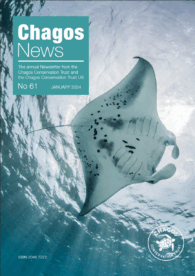
Many species – including the endemic Chagos clownfish (Amphiprion chagosensis) – linger near the shores of the islands. There are notable populations of open ocean fish such as manta rays (Manta birostris), sharks and tuna, and types of larger wrasse and grouper that cannot be found in other reefs in the region.
The establishment of the Chagos Marine Reserve and the ban on fishing has protected species such as the skipjack (Katsuwonus pelamis) and yellowfin tuna (Thunnus albacares). In the past, as many as 25,000 tonnes of these species were caught by international fishing fleets as they passed through the islands’ waters on their year-long migratory journey. Before protection, around 10,000 sharks were caught each year as accidental bycatch by boats fishing around the archipelago. Protection has stopped this, though threats from illegal fishing of tuna, sharks and other species remain an issue.
Among the types of fish that populate the waters around the islands is the bigeye tuna (Thunnus obesus), a deep-water fish that occupies nearly all of the world’s oceans within 45-degrees of the equator. It can grow to up to 2.5m in length with up to 200kg of high performance muscle. The bigeye tuna is a one of the most commercially-sought-after species of tuna, and as a result of its overfishing, it has been listed as vulnerable by the International Union for Conservation of Nature (IUCN).
The silky shark (Carcharhinus falciformis) is commonly found near the edges of continental shelves, from the surface to depths of up to 50m. It feeds on bony fishes and cephalopods, and often follows schools of tuna. As a result, the species is frequently caught by tuna longline and purse seine fisheries. It is also hunted for its fins, with many being sold in the Hong Kong shark fin market. The IUCN has designated the global silky shark population as near threatened.
Protection of the seas around the Chagos Archipelago has provided a sanctuary where marine species can rebuild natural populations.
Visit Fishes of Chagos here.
A number of natural forests can be found on the Chagos islands, as well as a diverse range of flowering plant life.
It is probably less than 4,000 years since the islands had sufficient soil to support certain flora. Its native species consists of around 41 species of flowering plants, four ferns, and a variety of mosses, liverworts, fungi and cyanobacteria.
As many as 280 species of plants and ferns can now be found here. Some settled when spores and seeds were brought to the islands by sea and wind. Some have been left by seabirds, while humans have introduced others – either deliberately or accidentally.
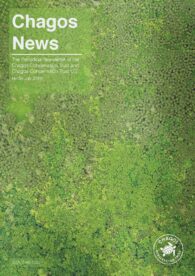
Some of these are invasive, and have become a threat to the native ecosystem. While some of the more unspoiled islands boast unique pisonia forests and large clumps of the gigantic fish poison tree (Barringtonia asiatica), many of the native forests were felled to make way for coconut palms used for copra oil production.
By studying the unspoiled islands, we can benchmark our work to re-establish native plant-life on heavily-altered islands elsewhere in the archipelago and indeed globally.
The remote islands of the Chagos Archipelago are perfect nursery sites for two valuable species of endangered turtles.
Turtles in the region were heavily exploited over the past two centuries but in the Chagos Marine Reserve populations have been recovering in recent years. The 400-800 green (Chelonia mydas) turtles and the 300-700 hawksbill (Eretmochelys imbricata) turtles that return to these islands to breed are considered globally significant. The IUCN considers the green turtle Endangered. The hawksbill turtle is unfortunately Critically Endangered, partly due to the black market demand for its beautiful shell.
These species of sea turtles can be found nesting on the beaches, and feeding in near-shore waters. While the islands were inhabited in the period from the 1760s, populations were heavily affected by their consumption by humans, as well as the impact of dogs, cats, pigs and rats, which ate their eggs and young.
Today around half of Diego Garcia is managed as a strict nature reserve, allowing adult female turtles to lay their eggs undisturbed. Turtle Cove – on the south end of the island – is a unique feeding site for sea turtles. Hawksbills are abundant on Peros Banhos and Diego Garcia, while green turtles nest in the Egmont Islands, Chagos Bank and Diego Garcia.
Sea turtles are among the oldest inhabitants of the planet, and are found in all oceans except the polar regions. However, they remain threatened globally by degenerating habitats, the effects of by-catch, and the problem of ingesting plastic bags mistaken for its favourite food of jellyfish. The worldwide population declined by more than 80% over the last century.
The full protection granted by the declaration of the Chagos Marine Reserve provides a safe haven for these turtles to breed helping these species to recover.
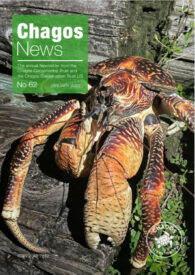
The coconut crab is among the most impressive invertebrate living in the Chagos Archipelago
The crab (Birgus latro) is the world’s largest terrestrial arthropod, with a leg-span of over a metre and weighing as much as 4kg. While it acts like a hermit crab in its early life, using empty coconut shells for protection, as it gets larger it dispenses with these.
Mature crabs can climb trees and even crack a coconut with their huge claws. On the islands of the Chagos Archipelago there are large populations of these crabs because of protection. Elsewhere it is a species that is threatened by over-collection, and is often used as fish-trap bait or as ornaments for sale to tourists. By protecting these healthy populations we can help to re-populate other habitats in the Indian Ocean region.
The coconut crabs here got their scientific name “latro” (or “robber”) from their habit of wandering into camps and making off with items such as food, pots, pans and even bottles of whisky.
There are others here, from the chirping hermit crab (Coenobita rugosus), which draws its claw against its seashell home like a violin bow to confuse predators. The strawberry hermit crab (C. perlatus) boasts colours ranging from vibrant orange to deep red. The fearsome looking red-clawed land crab (Cardisoma carnifex) the swift and elegant horned ghost crab (Ocypode ceratophthalma) and the competitive, pincer waving fiddler crab (Uca tetragonon) can also be found on the islands.
The archipelago is home to a diverse breeding seabird community, with more than 175,000 pairs of birds visiting each year.
Ten of the islands that make up the archipelago have been designated as Important Bird Areas by Birdlife International. Eighteen different types of breeding seabirds can be found nesting among these huge colonies, and restoring and conserving these habitats is a key aim of the Chagos Conservation Trust.
Among the most notable species that call these islands home are the sooty terns (Sterna fuscata), the brown and lesser noddies (Anous stolidus and A. tenuirostris), the wedge-tailed shearwaters (Puffinus pacificus) and the red-footed boobies (Sula sula).
The red-footed booby is the smallest of its family, with a fully-developed wingspan of around four and a half feet. It can be found nesting on the atolls in the summer months, and spends its winters out at sea. It can be recognised by its bright red feet, and while it lays only one egg a year, it lives for more than 20 years.
Threats to these species include loss of habitats, and the depletion of prey caused by over-fishing. Introduced rat colonies on the island also affect many ground-nesting species.
The protection of these islands, the removal of rats and the re-establishment of native forest are allowing seabird numbers to increase.
Visit Birds of Chagos here.